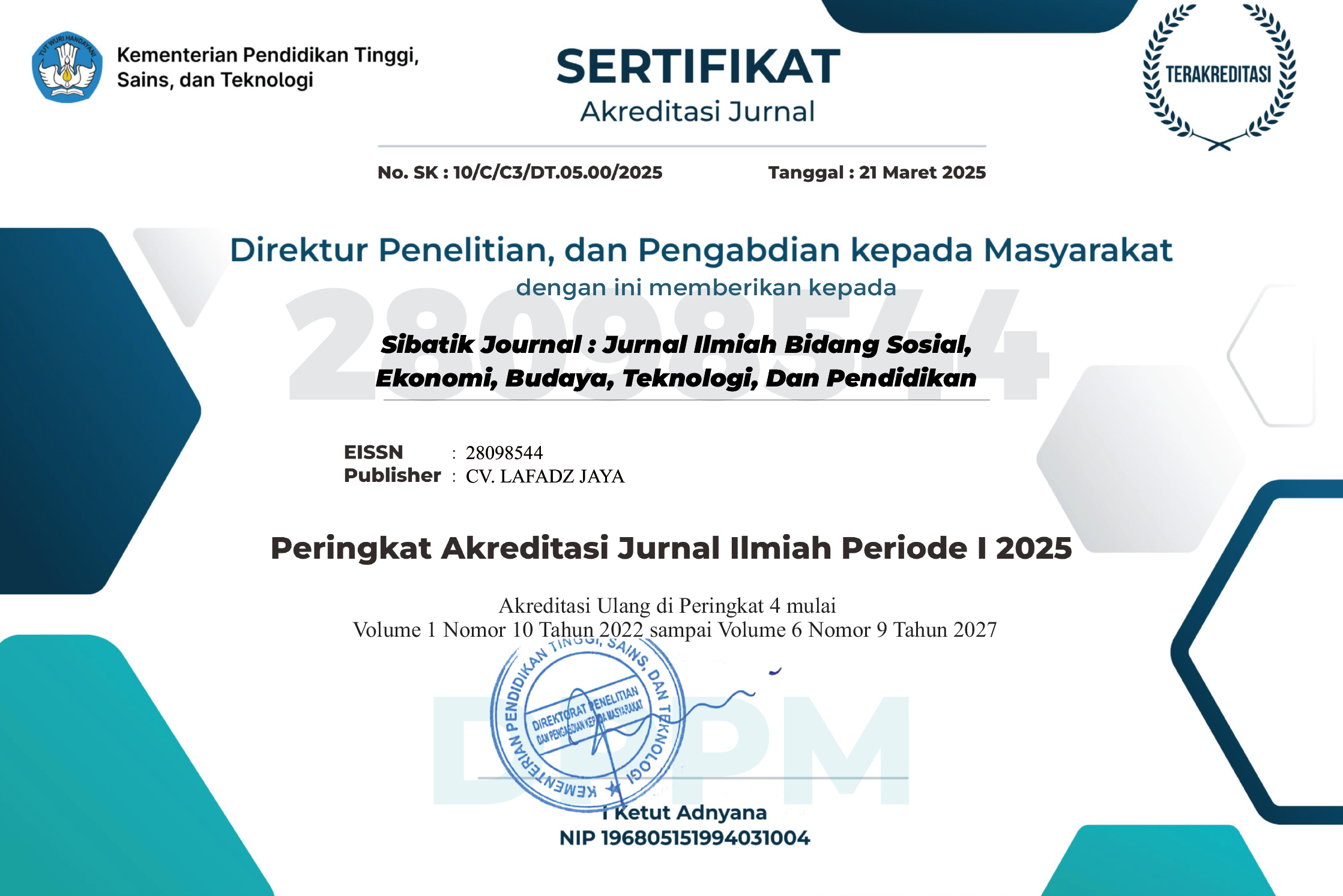
PENGARUH MENTAL ACCOUNTING DAN FINANCIAL BEHAVIOR TERHADAP FINANCIAL SATISFACTION
DOI:
10.54443/sibatik.v5i1.4221Published:
2025-12-31Downloads
Abstract
This study aims to analyze the influence of mental accounting and financial behavior on financial satisfaction among lecturers in Bengkalis Island. The research employs a quantitative approach using cross-sectional survey method. The population comprises all active lecturers in educational institutions on Bengkalis Island, with a sample of 207 respondents selected through convenience sampling. Data were collected using an online questionnaire and analyzed using Partial Least Squares Structural Equation Modeling with SmartPLS version 4.0. The findings indicate that mental accounting has a positive and significant effect on financial satisfaction with a coefficient of 0.137 and p-value of 0.045. Financial behavior also demonstrates a positive and significant influence with a stronger coefficient of 0.182 and p-value of 0.005. Both variables collectively explain only 5.4 percent of the variation in financial satisfaction, suggesting that numerous other factors influence financial satisfaction. The study concludes that structured financial management through mental accounting and healthy financial behavior are important components for enhancing individual financial satisfaction, although their contribution remains limited and requires integration with other factors such as financial literacy and emotional intelligence.
Keywords:
Financial Behavior Financial Satisfaction Accounting MentalityReferences
Ajzen, I. (1985). From intention to action: A theory of planned behavior. In J. Kuhl & J. Beckmann (Eds.), Action control: From cognition to behavior (pp. 11-39). Springer-Verlag.
Cahyatullah, & Hambali. (2024). Mental accounting and financial behavior of generation Z: The role of impulsive consumption reduction. Journal of Financial Literacy and Behavior, 8(2), 145-162.
Cresswell, J. W., & Cresswell, J. D. (2018). Research design: Qualitative, quantitative, and mixed methods approaches (5th ed.). SAGE Publications.
Emzir. (2012). Metodologi penelitian kualitatif: Analisis data dan penelitian kualitatif. Raja Grafindo Persada.
Fishbein, M., & Ajzen, I. (1975). Belief, attitude, intention and behavior: An introduction to theory and research. Addison-Wesley.
Firmansyah, Wijaya, A., & Rospitadewi. (2025). Structured mental accounting and financial security: A pathway to reduced financial stress. International Journal of Consumer Studies, 49(1), 78-95.
Global Financial Literacy Excellence Center [GFLEC]. (2024). 2024 S&P Global FinLit Survey. George Washington University.
Hakim, M. Z., Nugroho, L., & Khotimah, S. (2014). Behavioral finance and personal investment decision making. Jurnal Manajemen Teknologi, 13(1), 39-56.
Herdjiono, I., & Damanik, L. A. (2016). Pengaruh financial attitude, financial knowledge, parental income terhadap financial management behavior. Jurnal Manajemen Teori dan Terapan, 9(3), 226-241.
Humaidi, Suharyono, & Suharyanto. (2020). The influence of personality traits and financial literacy on personal financial management behavior. Journal of Financial Counseling and Planning, 31(2), 190-208.
Joo, S. H., & Grable, J. E. (2004). An exploratory framework of the determinants of financial satisfaction. Journal of Family and Economic Issues, 25(1), 25-50.
Kholiah, I., & Iramani, R. (2013). Studi experienced utility dalam pengambilan keputusan keuangan individu. Jurnal Manajemen Bisnis Indonesia, 2(3), 253-271.
Lathiifah, D. N., & Kautsar, A. (2022). Financial behavior and life satisfaction: A study among millennials in Indonesia. Psychology and Education Journal, 59(2), 245-260.
Memon, M. A., Cheah, J. H., Ramayah, T., Ting, H., & Chuah, F. (2025). Convenience sampling. In Encyclopedia of Organizational Behavior (pp. 156-162). Edward Elgar Publishing.
Nobriyani, & Haryono. (2019). Faktor-faktor yang mempengaruhi pengambilan keputusan keuangan pribadi. Jurnal Akuntansi dan Keuangan Indonesia, 16(1), 1-18.
Nofsinger, J. R., & Baker, H. K. (2010). Behavioral finance and wealth management. John Wiley & Sons.
Nurkhalida, Wijaya, A., & Hermawan. (2025). Financial behavior as a mediator between financial literacy and financial satisfaction: A structural equation modeling approach. Journal of Financial Research, 52(3), 312-332.
Otoritas Jasa Keuangan [OJK]. (2022). Survei nasional literasi dan inklusi keuangan (SNLIK) 2022. OJK.
Radianto, W., Sutisna, A., & Kristianto, H. (2022). Mental accounting pada pengusaha muda dalam pengelolaan keuangan bisnis. Jurnal Manajemen Sumber Daya Manusia, 16(1), 45-62.
Rospitadewi, & Efferin, S. (2017). Mental accounting behavior of dual-earner households in managing household finance. Asian Journal of Business and Accounting, 10(1), 55-84.
Satriadi, Widiastuti, & Suprianto. (2023). The impact of financial literacy and emotional intelligence on financial decision making: A study of Indonesian educators. International Journal of Educational Research and Social Sciences, 4(3), 412-431.
Sugiyono. (2022). Metode penelitian kuantitatif, kualitatif, dan R&D (9th ed.). Alfabeta.
Sudaryono. (2017). Metodologi penelitian: Kuantitatif, kualitatif, dan mixed method (2nd ed.). Rajagrafindo Persada.
Thaler, R. H. (1985). Mental accounting and consumer choice. Marketing Science, 4(3), 199-214.
Thaler, R. H. (1999). Mental accounting and consumer decisions. Journal of Decision Making, 4(3), 183-206.
Utami, I. (2023). Mental accounting, cognitive biases, and investment behavior among Indonesian investors. Economic Education Analysis Journal, 12(2), 178-195.
Van Le, T., Ha, V. S., & Duc, H. T. (2024). Financial management structure and perception of financial satisfaction: Evidence from Vietnam. Journal of Finance and Economics, 48(2), 203-221.
Wibowo, & Widianingsih. (2025). Psychological factors and financial decision-making in digital era: A systematic review. Digital Economics Review, 7(1), 89-108.
Wicaksono, & Divarda. (2015). Perilaku keuangan individu: Perspektif psikologi konsumsi. Jurnal Psikologi Ekonomi dan Bisnis, 5(2), 127-145.
Wijaya, A., & Widjaja, I. (2022). Financial behavior and financial satisfaction: The role of financial planning and money management. Journal of Personal Finance and Wealth Management, 3(1), 45-67.
Yuniningsih. (2020). Behavioral finance: Teori dan aplikasi dalam manajemen investasi. Jurnal Manajemen Keuangan Kontemporer, 2(1), 1-20.
License
Copyright (c) 2025 Fatra Istisqa, Novira Sartika

This work is licensed under a Creative Commons Attribution 4.0 International License.
Downloads
How to Cite